Session Data
- Date: 28/09/2026
- Time: 20:38 – 22:40UT
- Seeing: III. OK – Moderate
- Transparency: IV. Poor with heavy haze
- Temp: 132C,
- Air Pressure: 1017mb
- Humidity: 92%
- Dew Point: 11 C
- Wind Speed: 6 mph
- Average SQM: 19.15magn/arcsec^2
Scope: Altair 150mm RC f/6 Camera: Player One Ares M Pro. Darks and Flats subtracted
All images are displayed North to the top and East to the left.
Tonight was more of a test of my new mount, the WD-17 strain wave from Warpastron but this time with the Altair 150mm RC with the focal reducer fitted, giving me f/6. While I would prefer to use the ASI183 camera with its larger FOV, but the IMX533 chipped Player One is much less noisy and doesn’t suffer from amp glow. I’m still using darks, more out of habit than anything else, and I’m not sure I really need them.
Click the images to display at full size.
NGC6720
Located : +01°10’32.3″ PA:287° from Gamma Lyr in Lyra
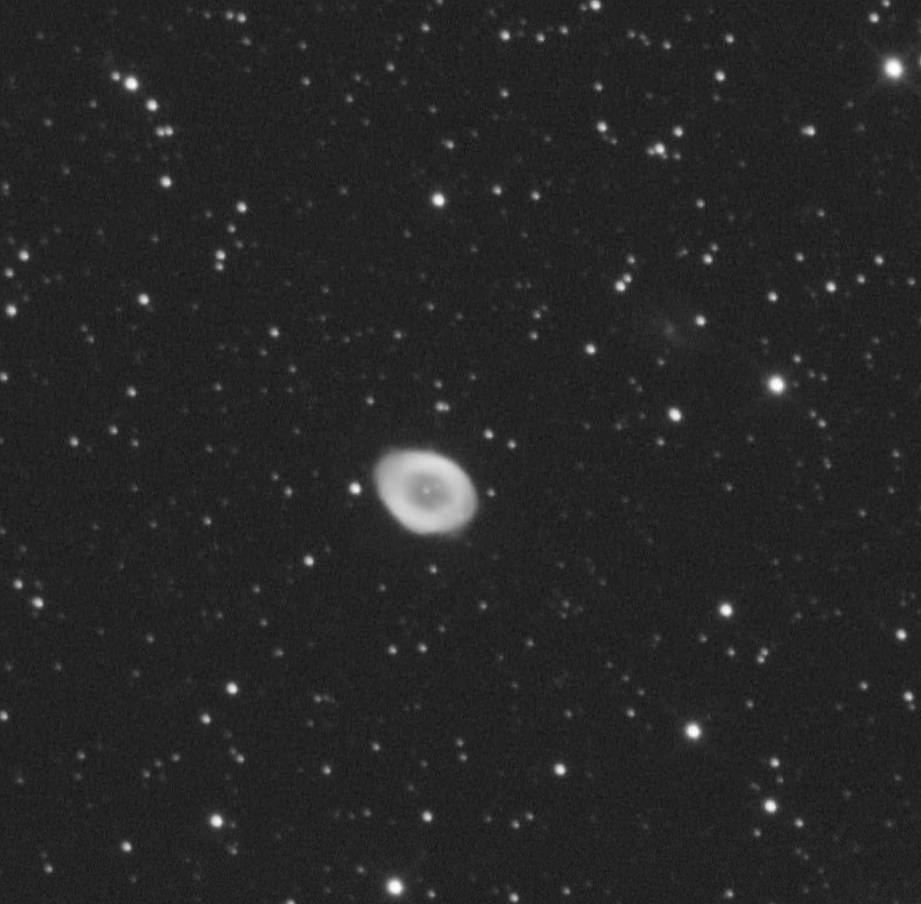
Our target is set in a fairly busy star field. At full frame the brightest star is HD175577 at 8.7 mag to the East. 4 arc min to the NW is a 15.3 mag galaxy IC1296. While really faint, it does look like a barred spiral with its reversed S shape. There are a number of small PGC galaxies marked to the East and NE, but these are only faint smudges at this exposure
Our target looks like a squashed oval Taurus. The elongated ends appear more transparent than the sides. The longest dimension is about 1:30 arc mins long and this is aligned along an NE/SW orientation.
Inside this smokey ring is a more transparent oval void, but this is brighter than the sky background. The inner void is full of ionized OIII , the surface brightness of which masks the central star when viewed visually for most observers. I’ve never seen it visually, even through my 250mm RC. This star was first recorded in around 1800 by Freidrich Hahn, who observed it using a 12″ reflector. See page 43 of Wolfgang Steinicke’s book ‘Observing and cataloging Nebulae and Star Clusters’ for the wonderful accounts made of NGC6720. There is also a second star just off to the NW. This looks to be Gaia DR3 2090486687506009472 at 18.46 mag.
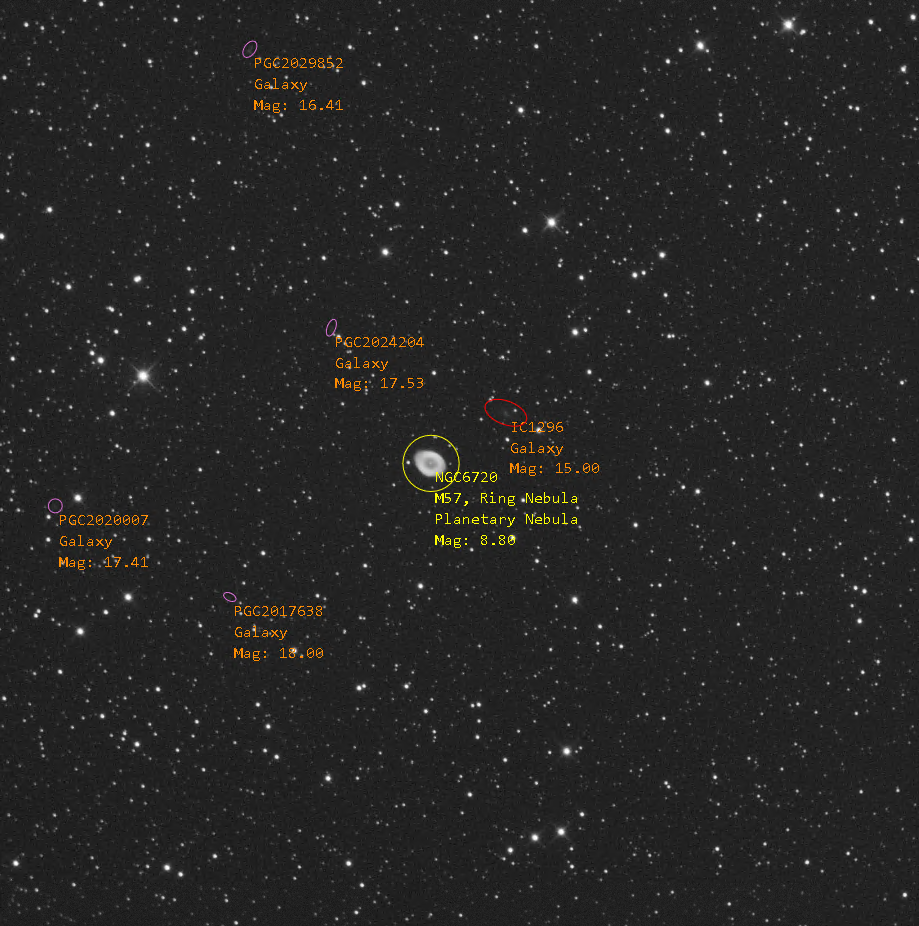
Total Integration Time: 480 sec
NGC650
Located +10°57’26.1″ PA:254° from Eta Persei in Perseus
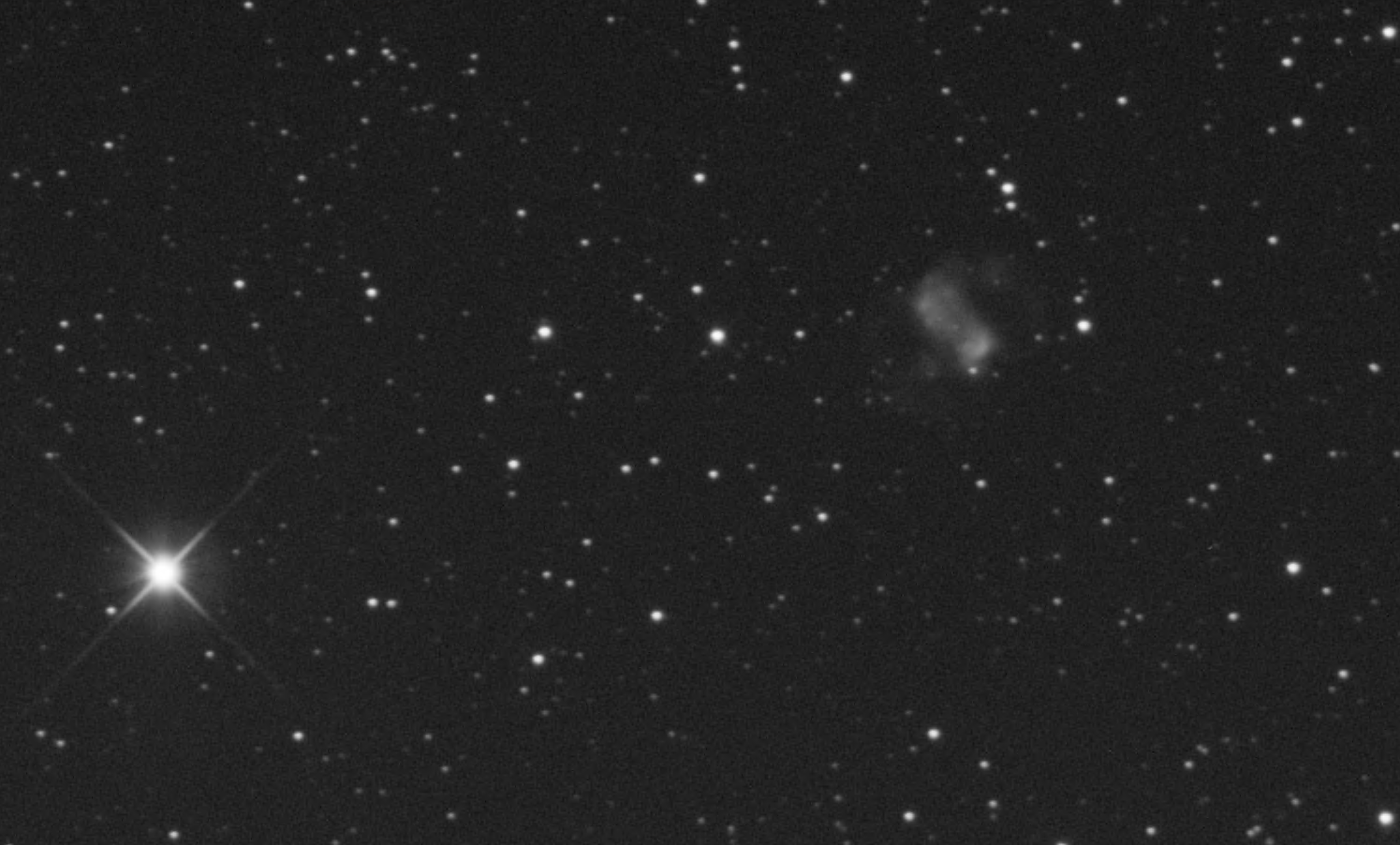
Our subject lies is a fairly busy star field. The bright star in the FOV is HIP 8065 to the East. There are a number of identified PGC galaxies, but these are just faint smudges with no determinable structure.
NGC650 is quite elusive even after 8 mins of integration. It has visual properties of a barred spiral. The core orientated NE/SW is rectangular in shape and is brighter at the SW end. The centre of the rectangular is fainter than the ends. From the NE end is a faint arc of dust curling around it in a clockwise direction, with an opposite rotating arc coming out of the NE end of the bar. The whole structure measures 2:30 arc-mins in diameter
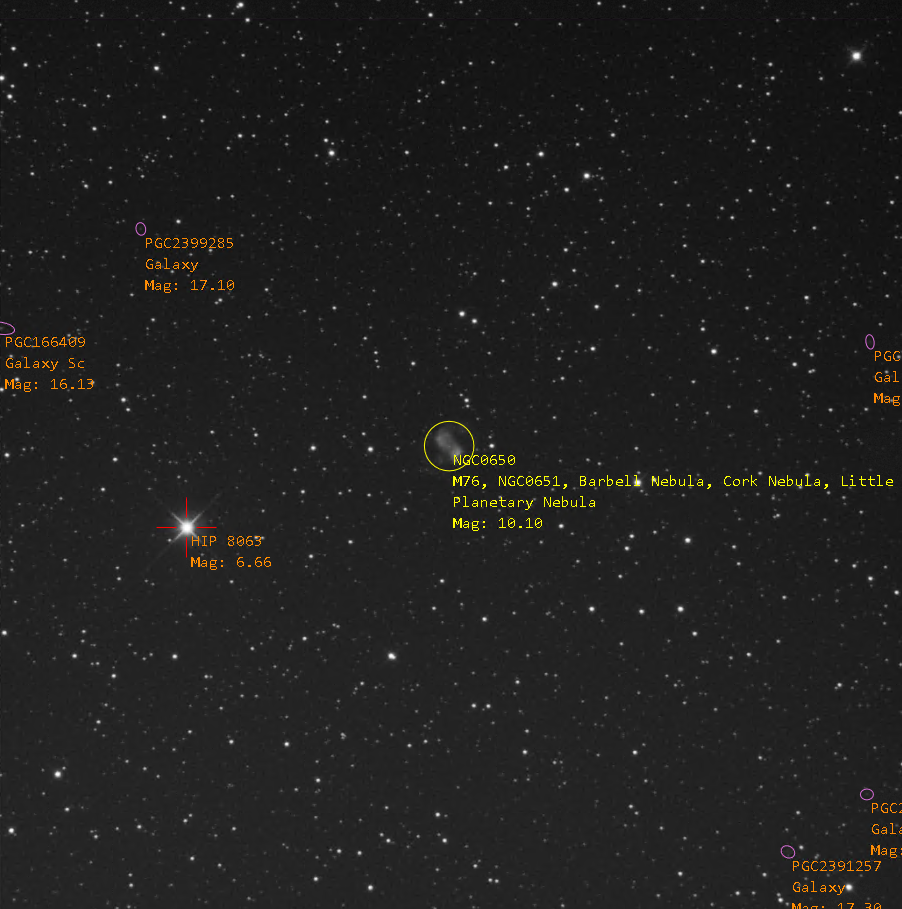
Total Integration Time: 525 sec