Session Data
- Date: 25/09/2025
- Time: 20:30 – 23.55 UT
- Seeing: II. Good – Slight
- Transparency: II. Clear with some cloud
- Temp: 11 C,
- Air Pressure: 1026mb
- Humidity: 82%
- Dew Point: 0C
- Wind Speed: 2mph
- Average SQM: magn/arcsec^2
Scope: TMB 80 f/6 Camera: ZWO ASI 183MM. Darks but no Flats
All images are displayed North up and East to the left. Click image to view full size.
Collinder 440, NGC7128
Located 13.0 degrees PA 45 degrees of Alpha Cyg in Cygnus.
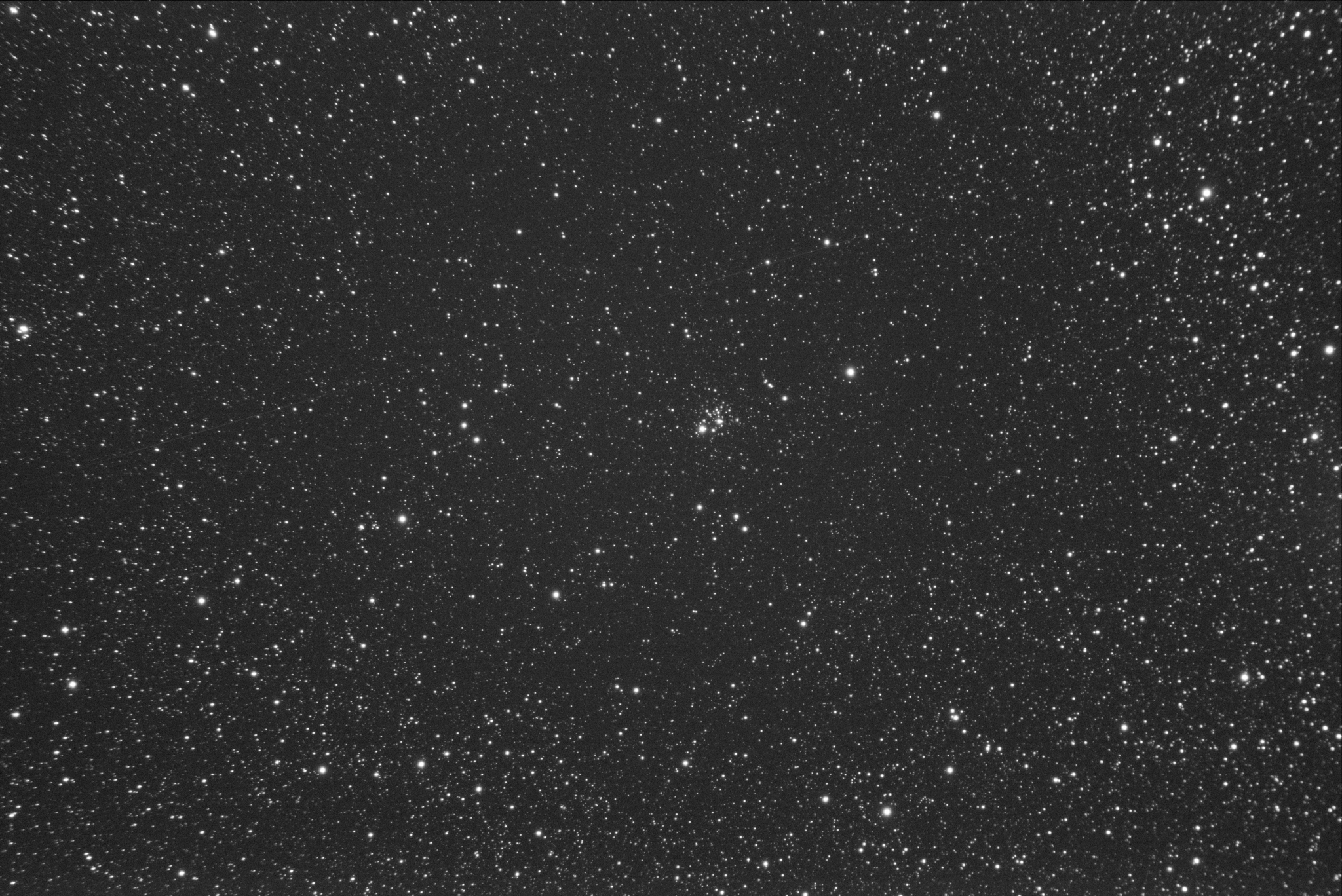
A poor instrument choice for this target – I should have used the RC. Nevertheless, this is a pretty little cluster at 3 arc min in diameter. The two brightest stars are 9.6 mag and 11.0 mag, this the remaining 10 or so stars of 12.0 to 14.0 mag and fainter. The group looks like an isosceles triangle with a small chunk taken out of it to the NE. It seems to sit is a darker patch of sky with fewer stars which extends out to about 24 arc mins from the frame centre.
Total Integration Time: 270 sec
Collinder 445, IC1434
CR444 is located 2.0 degrees W of 3 Lac in Lacerta
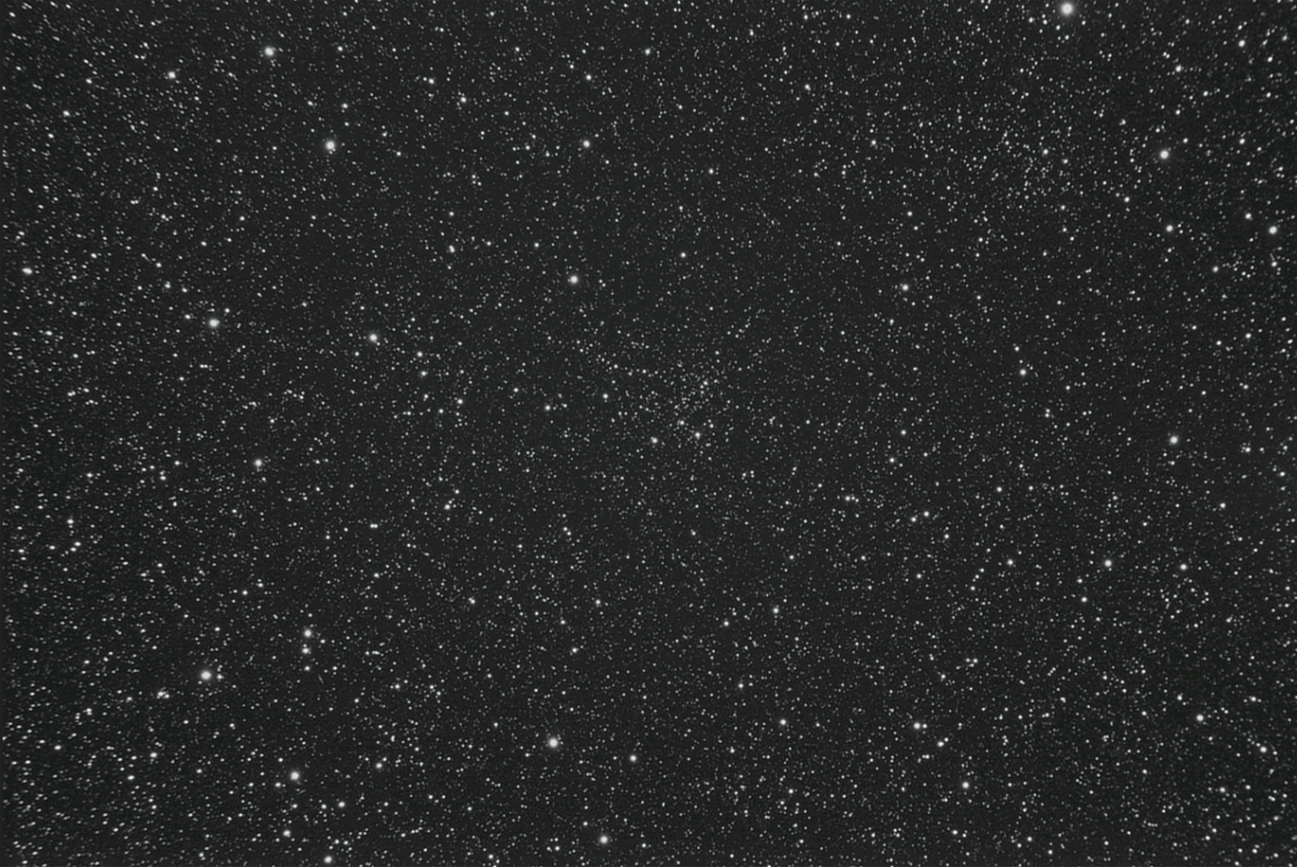
This is a really busy star field and you could pick out any number of star groupings in this image and call it a cluster. However the cluster is in the centre here and you immediately see three bright 10 and 11th mag stars forming a triangle.
From the top centre one is a line of stars that goes north and west before turning north and east. If you are a sailor you might think this looks like a side on view of a CQR anchor. This shape extends far beyond the clusters official diameter of 7 arc sec which only contains a total of 5 stars including the 3 mentioned here.
Total Integration Time: 225 sec
Collinder 446, NGC7226
CR444 is located 2.0 degrees S of 21 Cep in Cepheus
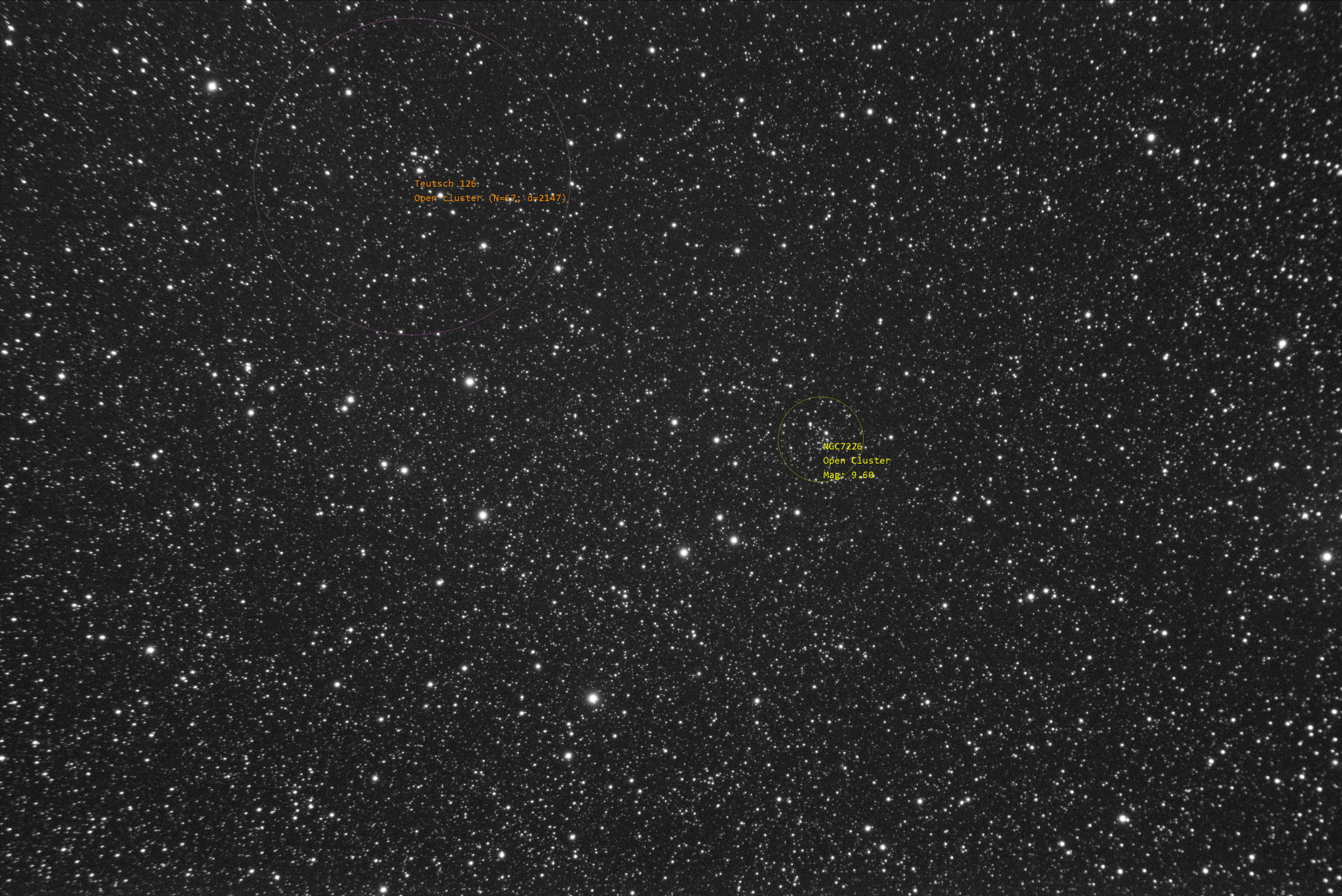
OK. This is a really small cluster at 1.8 arc in diameter and I should have used a larger scope to observe this target. The brightest star is 15.6 mag with a grouping of about a dozen 13-14 mag stars to the South and East of this star.
To the NE is the much larger cluster, Teutsch 126, the brightest stars of which form an upright Y shape with the tail leaning towards the West. Simbad quotes this a being 11.2 arc mins in diameter.
If you were looking at this field visually, both these object blend into the background star field and would be unnoticeable.
Total Integration Time: 75 sec
Collinder 456, NGC7686
CR456 is located 20.0 degrees W of 51 And in Andromeda
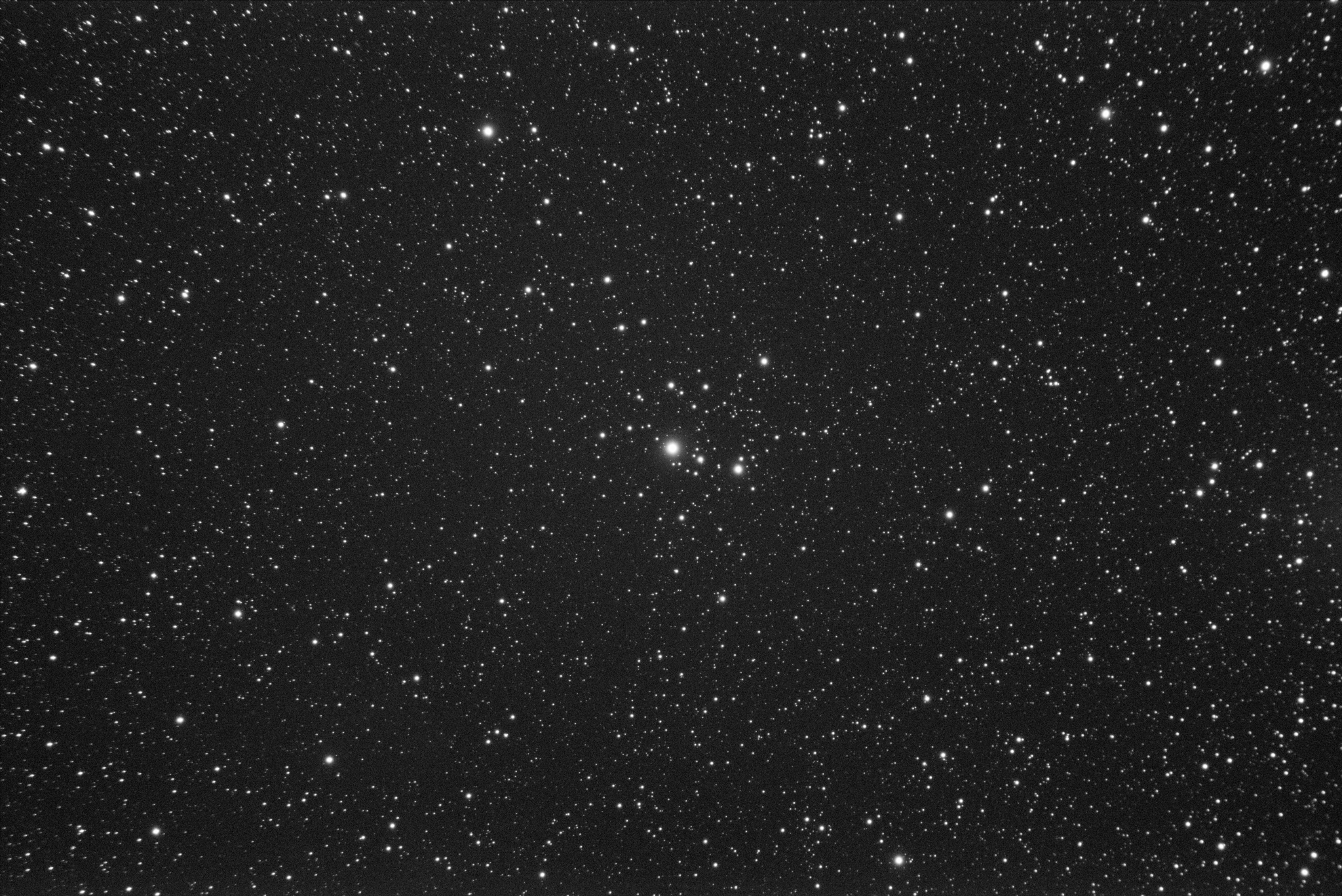
Finally. A large enough cluster that is obvious. Quoted as being 14 arc sec in diameter, this cluster is centred on the 6.2 mag K5III star HD221246. I see a lozenge shape of four stars with the lower tip of the lozenge pointed to the South. These four stars range from 9.5 – 10.4 mag. The cluster has a bias of fainter stars towards the West. This would have been nice to have seen in colour as there are a total of Six orange stars withing an 18 arc min radius of HD221246.
Total Integration Time: 120 sec
Collinder 459, NGC7788
CR459 is located 2.75 degrees NW of Beta Cas in Cassiopeia
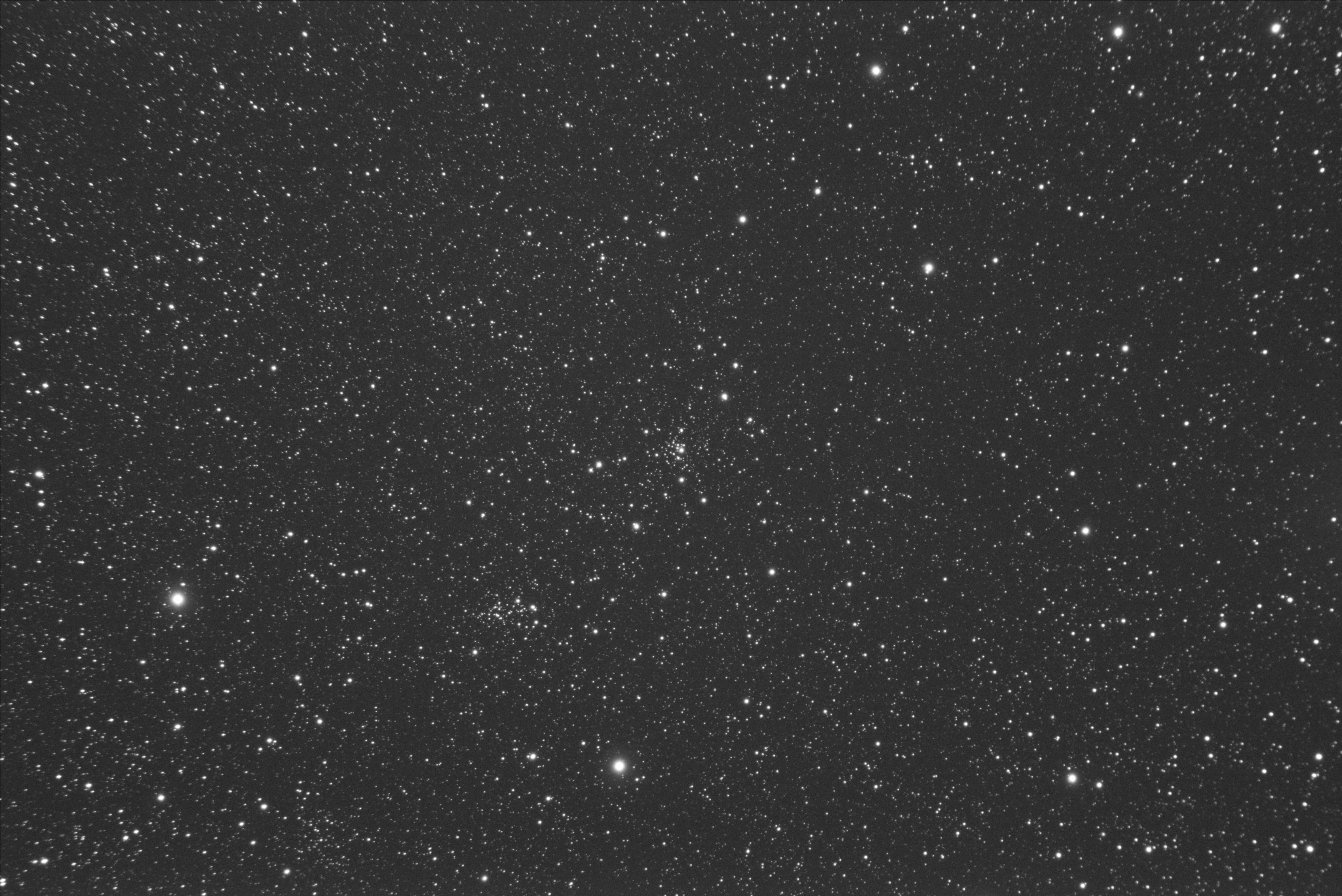
This is quite a crowded star field with our target in the centre of the frame. Collinder 459 is only 9 arc min in size and contains half a dozen bright stars in the 10 to 11 mag range. The rest are 12 mag and fainter and these amount to maybe 30 stars. My eye picks out an optical line of stars curving around the star at the frame centre and pointing in a Northeasterly direction.
17 arc min to the Southeast is NGC7790 and that observation follows below.
Total Integration Time: 70 sec
Collinder 461, NGC7790
CR461 is located 2.75 degrees NW of Beta Cas in Cassiopeia
This is the second observation in the two for one category. In the same FOV as the observation of Collinder 459 above, this cluster just Southeast of the centre of the frame.
The size given is 17 arc mins but when you look at the concentration of stars here they have a better fit within a 5 arc min circle. The grouping has and East/West orientation with 4-5 stars of about 12 mag to the West with the other 20 or so fainter stars of 13 mag and fainter sprinkled across the middle of the 5 arc min circle.
Total Integration Time: 70 sec
Collinder 457, NGC7762
CR457 is located 6.0 degrees, position angle 65 degrees of Iota Cep in Cepheus
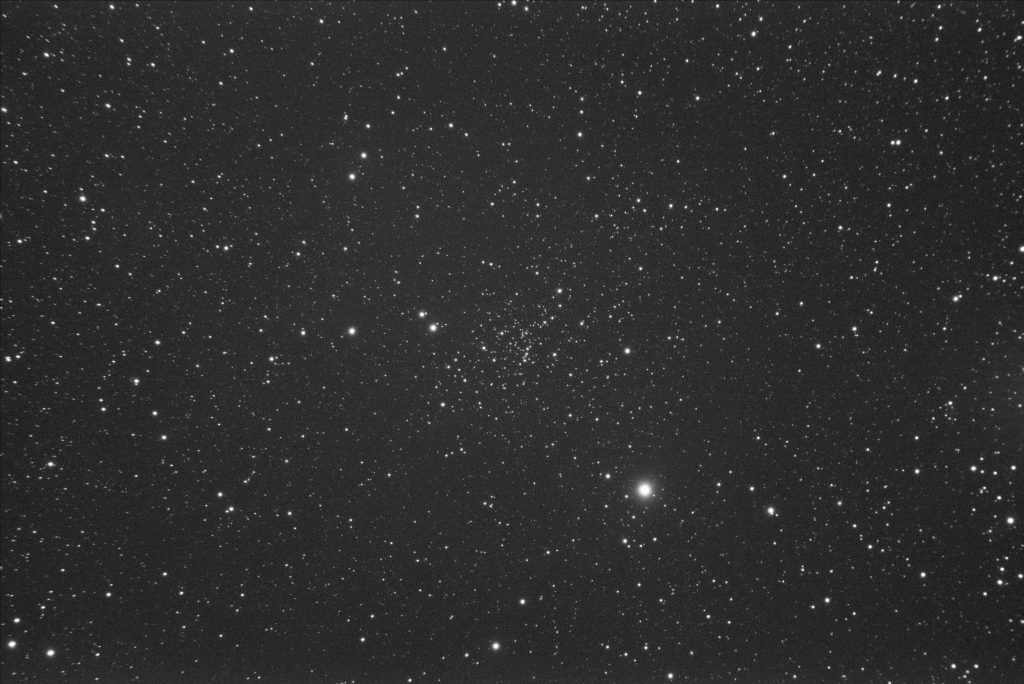
This is another of those clusters that is given a size much smaller than it looks when you first see it. My initial impression is that it is covered by a 20 arc min circle, yet NGC7762 size is given as 11 arc min. This larger grouping of stars has a SE/NW orientation.
The actual 11 arc min cluster forms a pc cursor shape and points in a Northwesterly direction. The stars that make up the corners of this shape are of about 12 mag with the other fainter stars of the cluster being of 13 – 14 mag and there are about 30 of them.
To the Southwest of the cluster shines the bright type A1Vn, 5 mag star, HD223275
Total Integration Time: 150 sec
SN2025rbs, NGC7331
Located in NGC7331 8.5 degrees PA320 degrees of Beta Peg in Pegasus
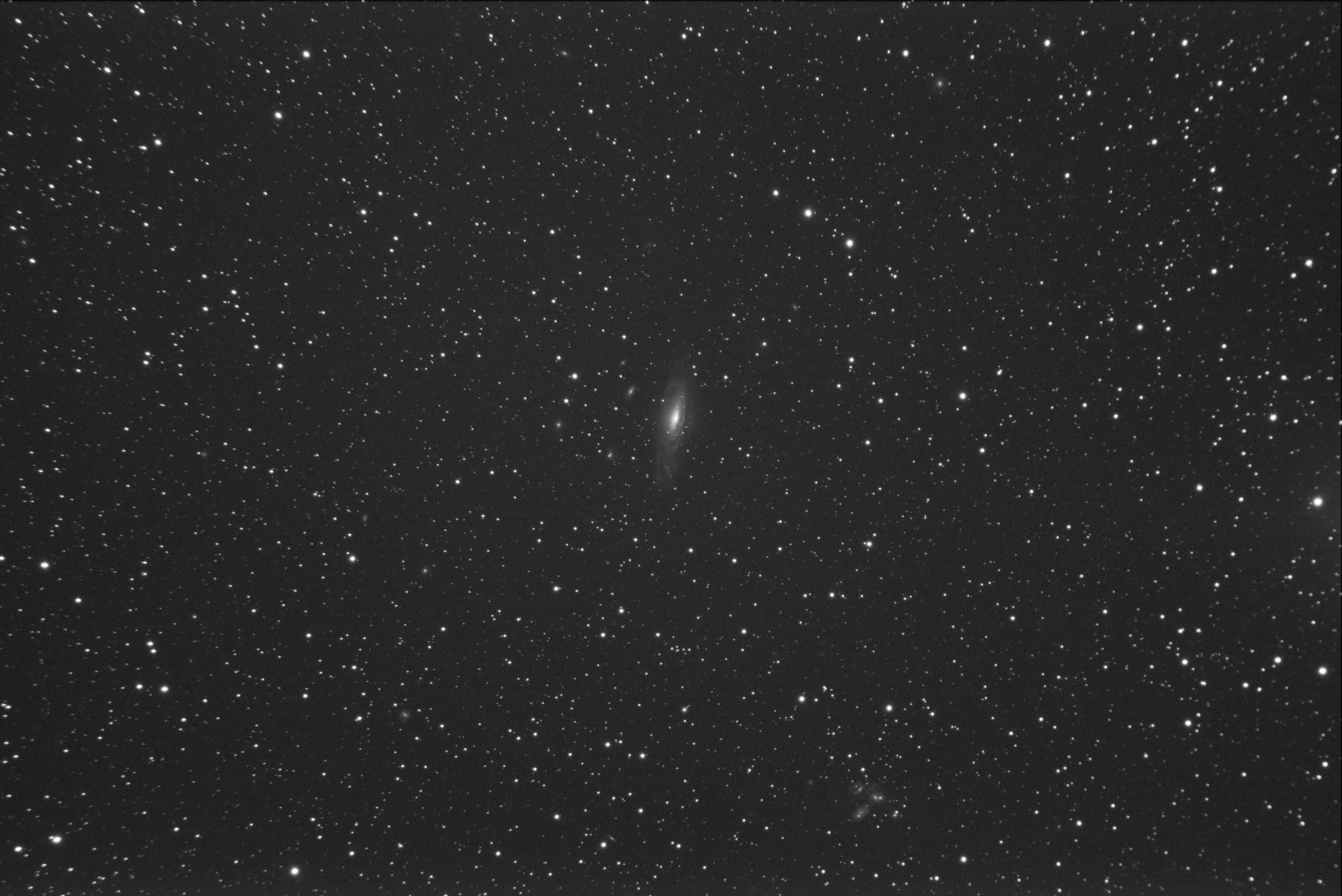
If you zoom in on the image above and use the annotated image below, you can just make out the SN to the NW of the bright core of NGC7331. I have already observed this galaxy on 2024-11-12, just search for it.
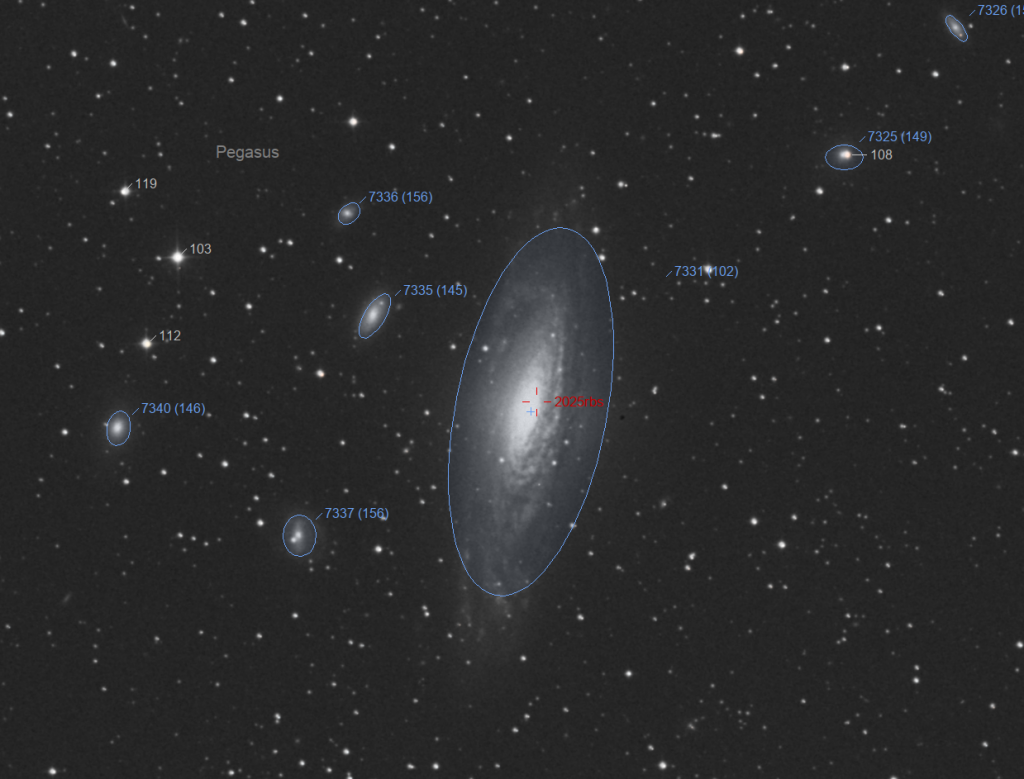
To the East of NGC7331 are a group of galaxies referred to as the fleas or the Deer Lick Group. The are NGC7336, NGC7335, NGC7340 and NGC7337. My image size is too small to be able to determine their type, but you can see that they all appear to be angled to our line of sight. Skytools 4 show all of these to be between 3 – 4 Gyr away, much further than NGC7331
7 arc min PA 308 degrees of NGC7331 is NGC7325 and to the North 12 arc min PA 8 degrees is the smudge of LEDA 2051985.
30 arc min PA 206 degrees is Hickson 92, which I have observed previously.
33 arc min ,PA 93 degrees is PGC69434 at 15.3 B mag
23 arc min, PA 107 degrees is PGC69402 also at 15.3 B mag
20 arc mi,n PA 120 degrees is PGC 69387 at 14.6 B mag and finally NGC7343 14.4 B mag at 28 arc min, PA 136 degrees
Total Integration Time: 990 sec
Collinder 2, NGC129
Located 2.8 degrees, PA 65 degrees from Beta Cas in Cassiopeia
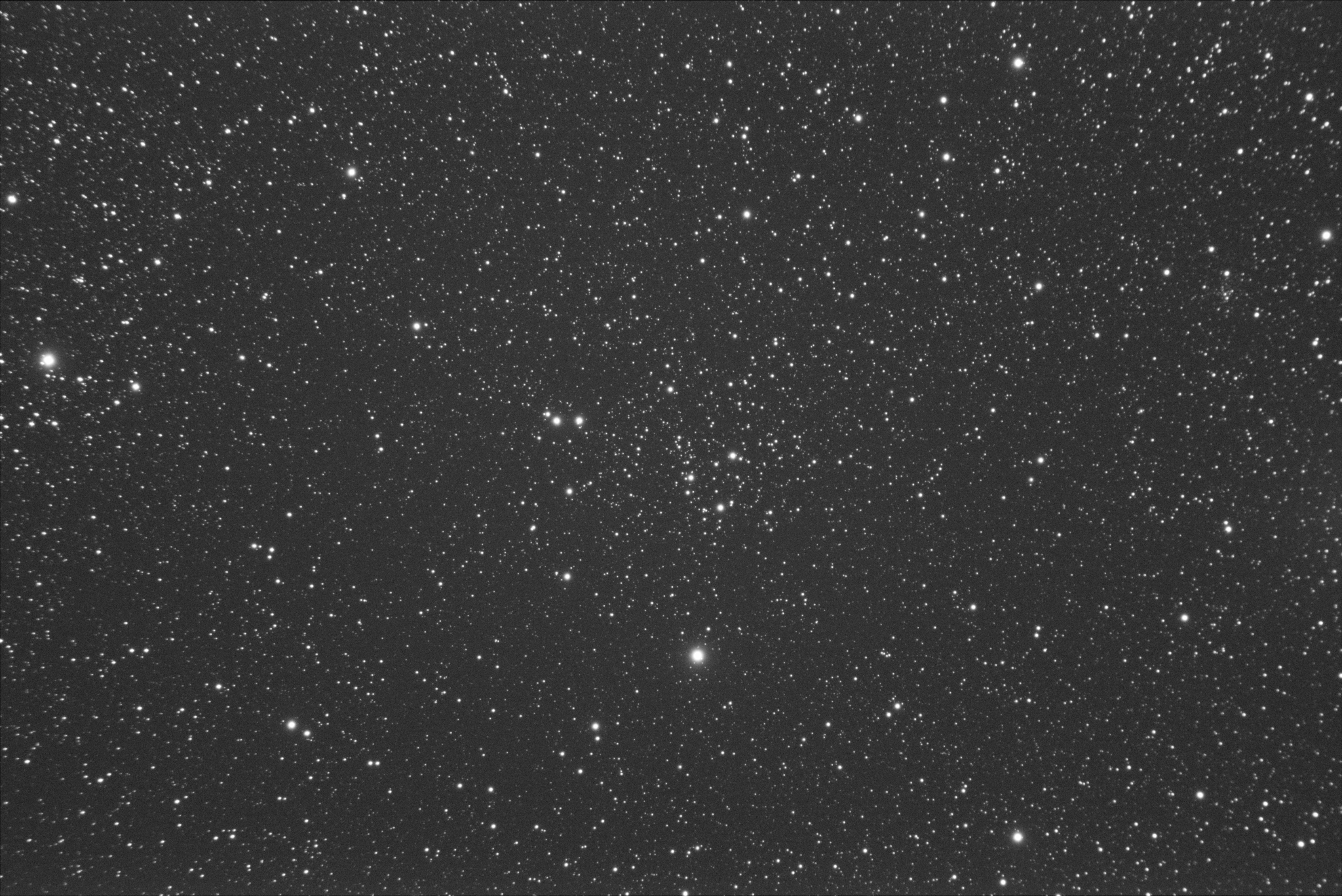
This cluster sits North of the brightest star in the frame, HD2626 at 5.9 mag. Three 9.0 mag stars sit at one end of a chain of stars that cascade North and a little East, before curving South and East. a little like a graph plot. At the end of this line is an inverted triangle of stars 8.6 – 9.4 mag.
Just off to the NW is the Open Cluster Berkeley 2
Total Integration Time: 120 sec
NGC896
Located 3.5 degrees, PA 116 degrees from Epsilon Cas in Cassiopeia
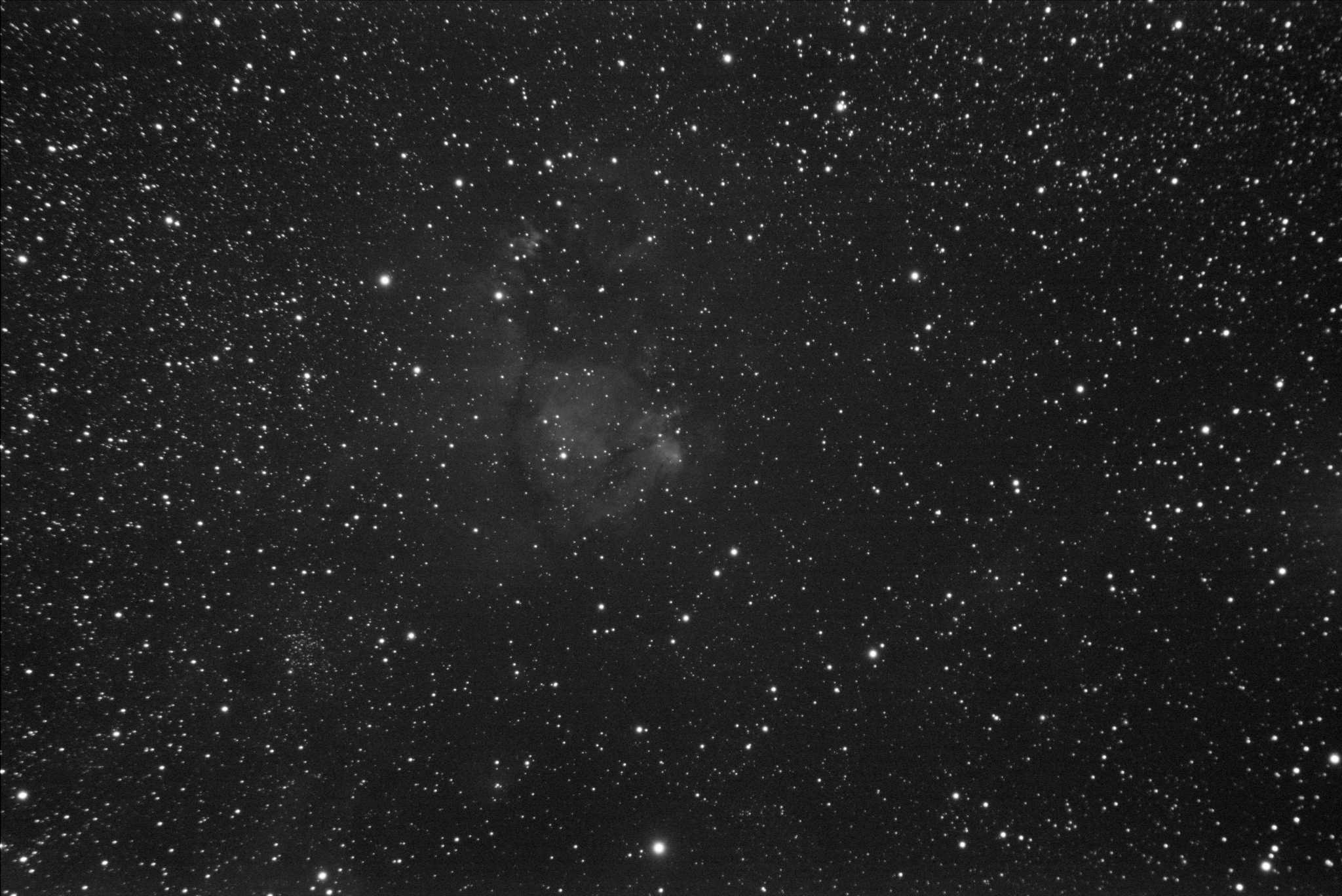
Called the Fish head nebula and you can see why. The head and the mouth are located at the centre of the frame looking West. Just behind the head to the East is a dark lane that separates it from more nebulosity to the East. This dark lane heads North and opens up into a dark lagoon. To the Northwest of this lagoon is another fainter area of nebulosity. This whole nebulous section covers a circle of about 30 arc mins in diameter.
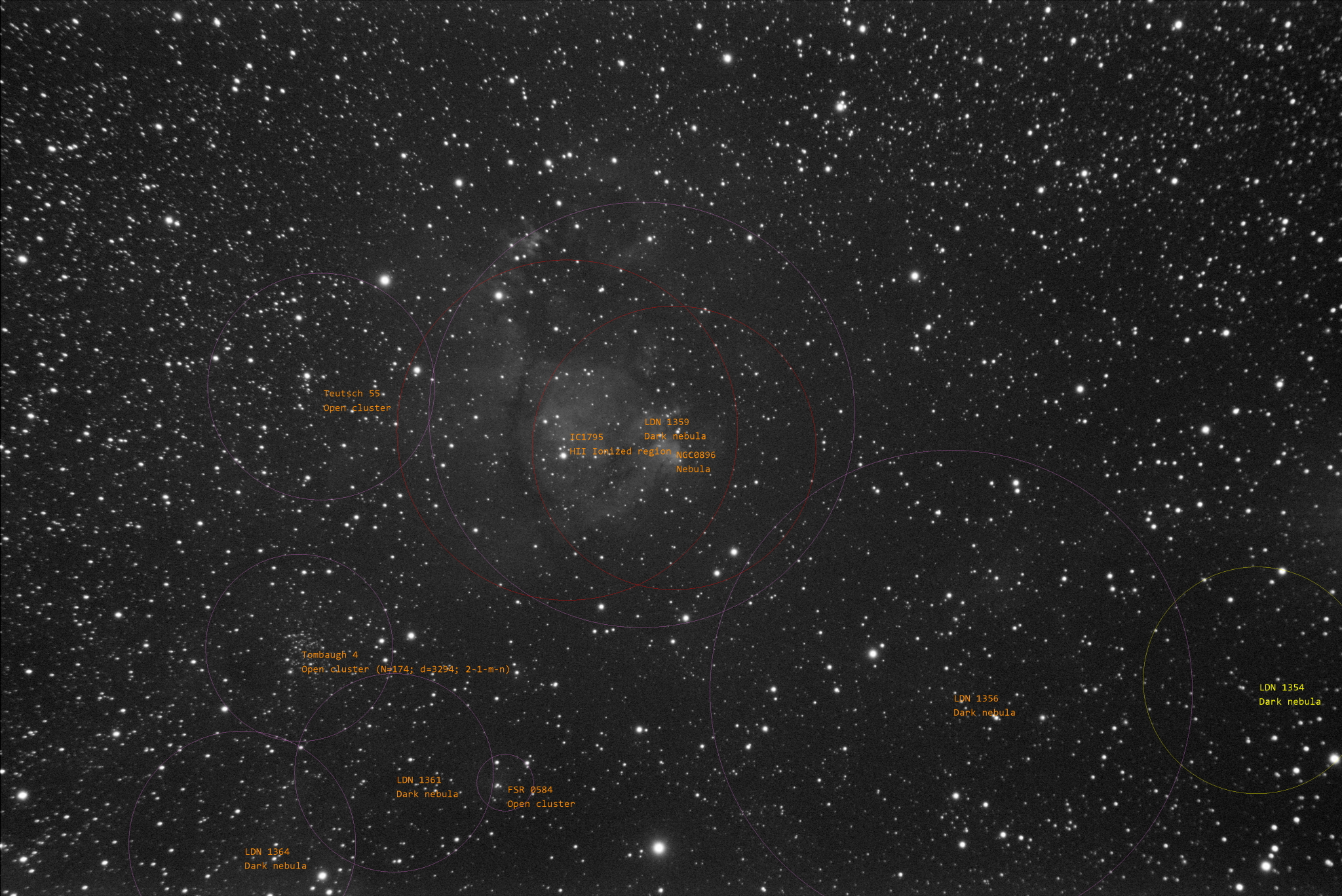
To the Sw are two dark nebula LDN1356 and LDN1354. Has Sharpcap not marked these I’m not sure I would have noticed these. The same goes for LDN1364 and LDN1361 to the SE.
The two clusters though are a little more prominent. Tombaugh 4 to the SE is a very compact grouping of faint stars and North of this is Teutsch 55 although again, would you have picked this out as a grouping had you not seen it marked on the image.
Total Integration Time: 495 sec
Stephenson 1
Located 2 degrees, PA 110 degrees from 6 Lyr in Lyra.
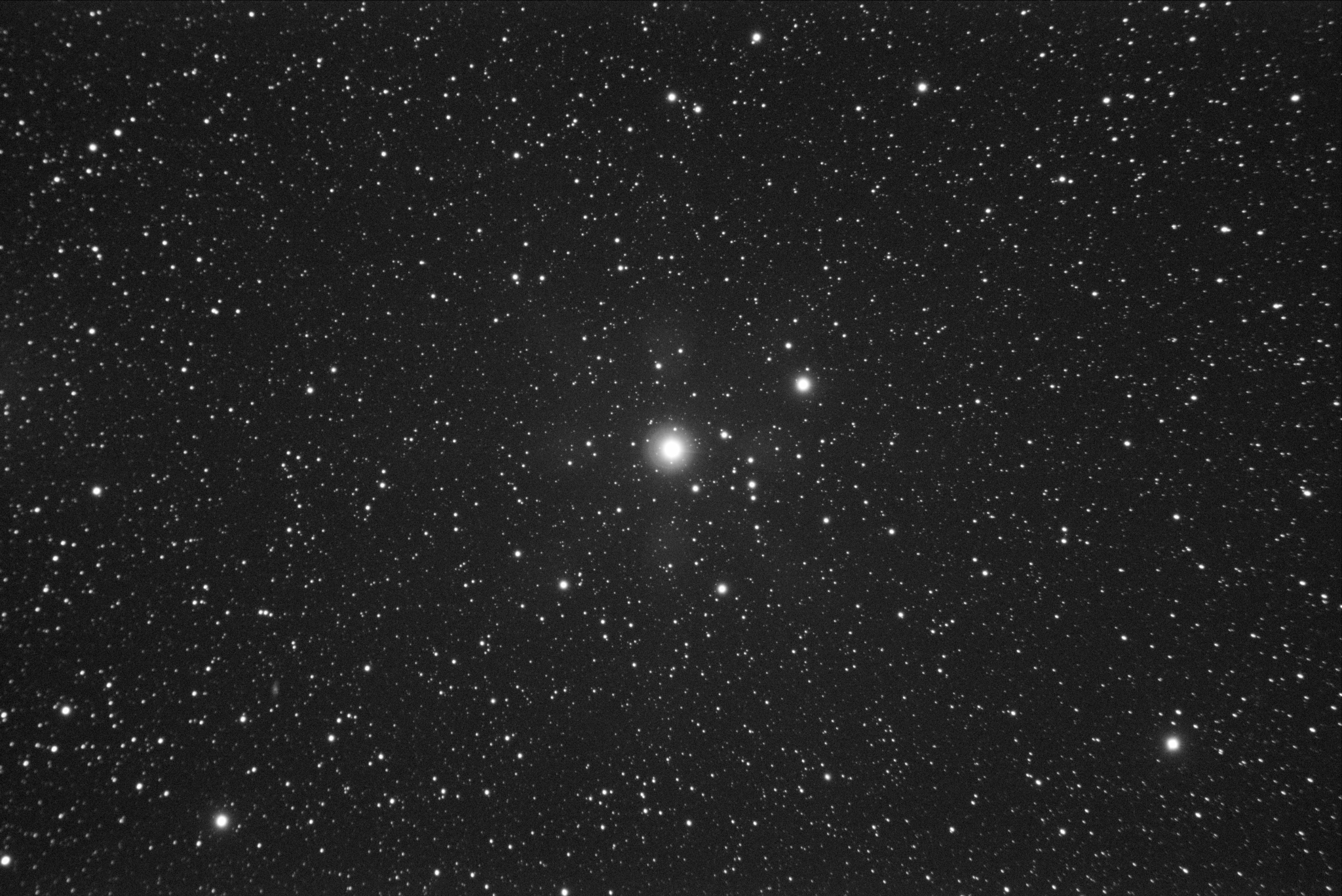
I’ll refer you to the first time under non optimum conditions that I observed this target on 12, November 2024. It’s visually no more interesting the second time round under much better conditions, but here it is.
The bright star is HD175588 at 4.3 mag and its smaller companion HD175426 at 5.6 mag.
To the SW of HD175588 is a small chevron of 6 stars 9-10 mag pointing to the NW…..NEXT
Total Integration Time: 105 sec
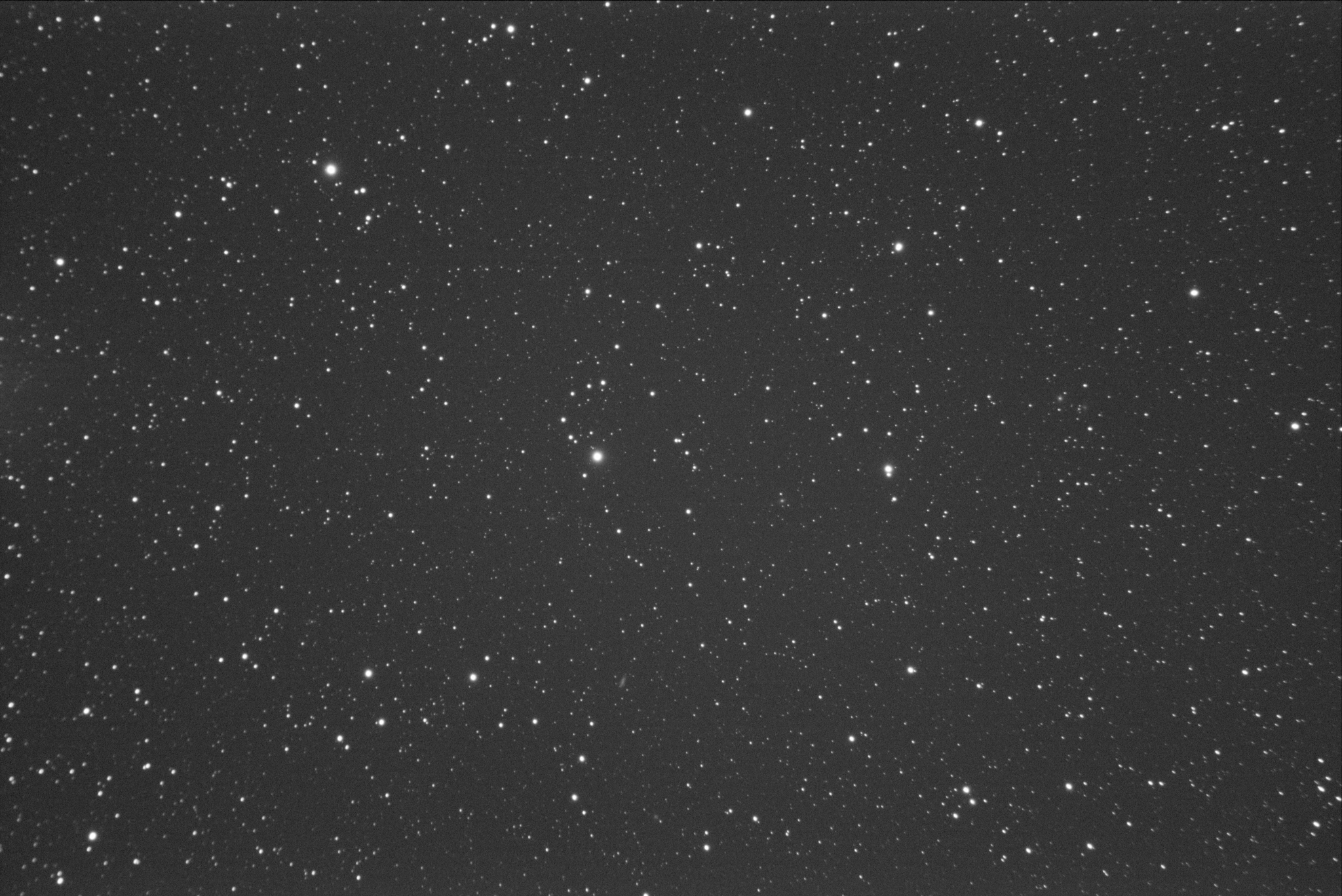
Webbs Wreath
Located 10 degrees, PA 80 degrees from Delta Her in Hercules.
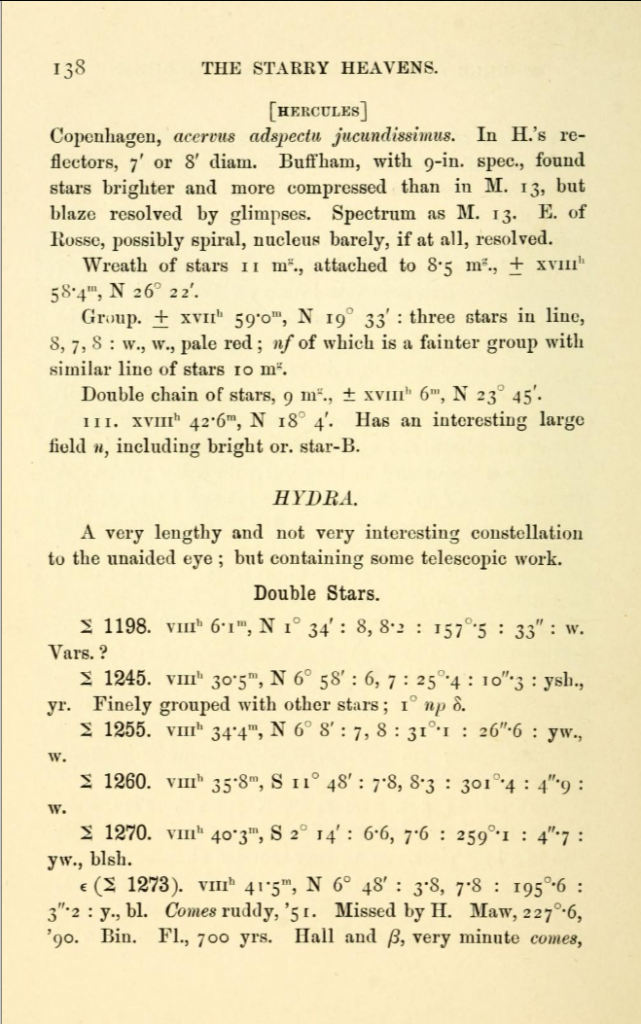
I thought this was going to be one of those silly Skytools 4 asterisums, but apparently it it was described in the 4th edition (1881) of Thomas Webb’s observing guide ‘Celestial Objects for Common Telescopes.’
It also has a full page in the May 2025 issue of S&T written by Stephen J O’Meara, who goes to great lengths to define what shape Webb may have thought a wreath was.
Anyway, what we have is a bright star, HD164922, a K0V 7.0 mag, just East of the centre of the frame and flowing from this is a clockwise direction a line of 6 maybe 7 , 11 mag stars.
For what it’s worth, finding out about this asterism, was more interesting than the actual observation of it, so my time hasn’t been entirely wasted.
Total Integration Time: 195 sec
Collinder 420, NGC6910
Located 33 arc min , PA 19 degrees from Gamma Cyg in Cygnus
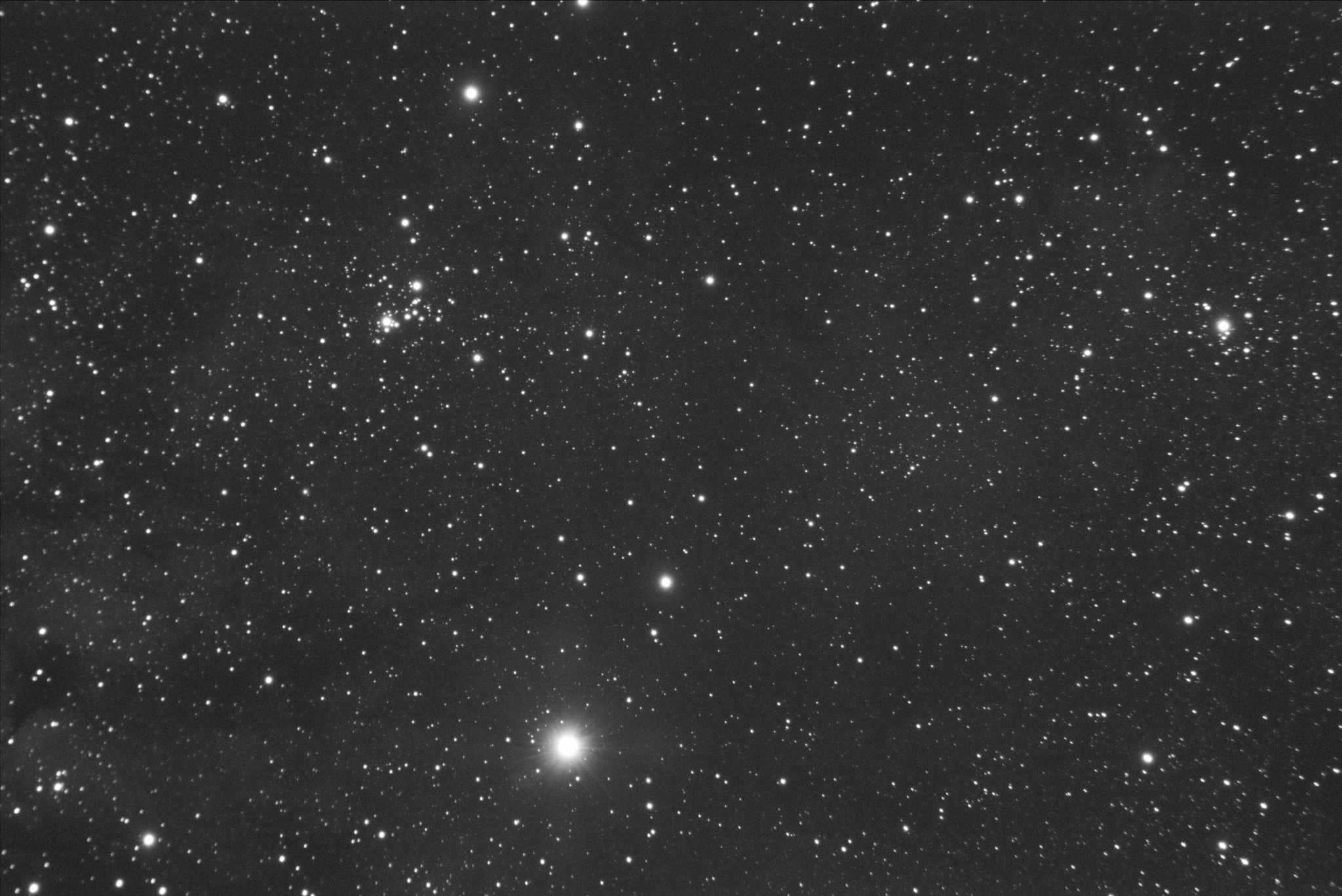
I’ve observed this a couple of times visually in September and October 2015.
What we have here is Gamma Cyg blasting away at the bottom of the frame . In the top left quadrant is our cluster which is compact and only covering 7 arc mins in diameter. Consisting of two bright stars HD194291, 7.4 mag and HD194279, 7.1 mag. Just glancing HD194279 us a curved line of seven 10-12 mag stars, and the rest are 13-15 mag of which there are about 20 or so.
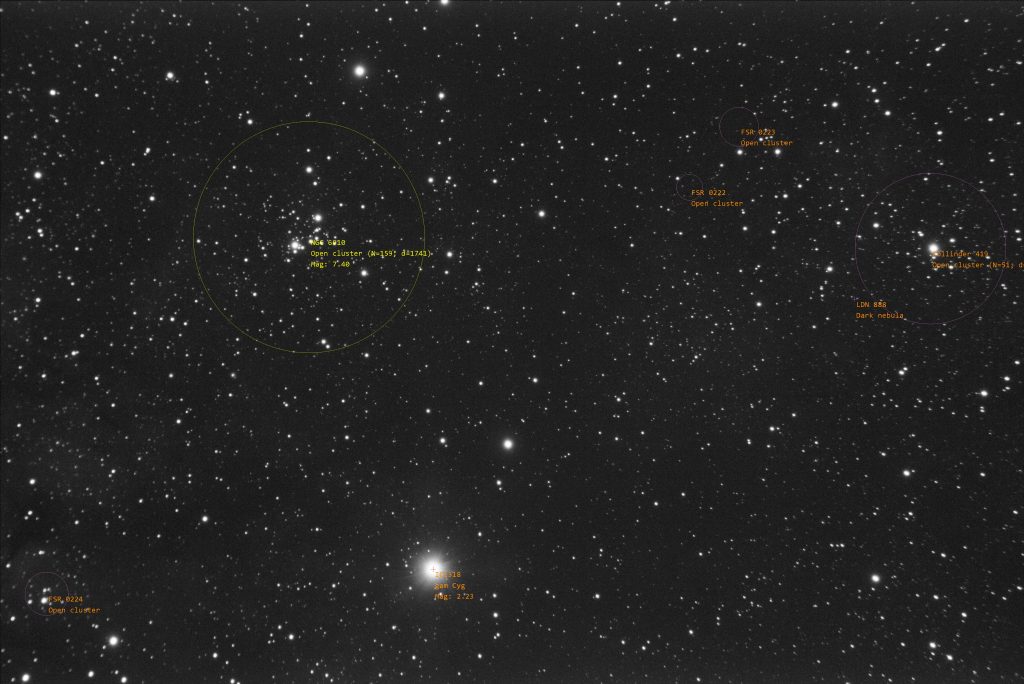
There are another of other clusters in the FOV, notably Collinder 419 – observed EAA in 2023 and visually in 2015. Sharpcap identifies three other clusters names as FSR223, FSR222 and FSR224. This is yet another cluster catalogue that I have never heard of.
In January 2007 three researchers Froebrich, Scholz and Raftery, used star density maps obtained from the Two-Micron All-Sky Survey (2MASS) to obtain a sample of star clusters in the entire Galactic Plane with |b| < 20° and wrote a paper ‘A systematic survey for infrared star clusters with |b| < 20◦ using 2MASS’. The ‘b’ refers to galactic latitude.
I’ve yet to read the paper to find out what this is all about, but you’ll find it here
https://articles.adsabs.harvard.edu/pdf/2007MNRAS.374..399F
The introduction suggests that using NIR surveys is a much better way of identifying both OC and GC in the Milky Way than those found from viewing optical surveys. I read introduction and think I understood what this surveys aims was, so that’s a plus.
Total Integration Time: 195 sec